
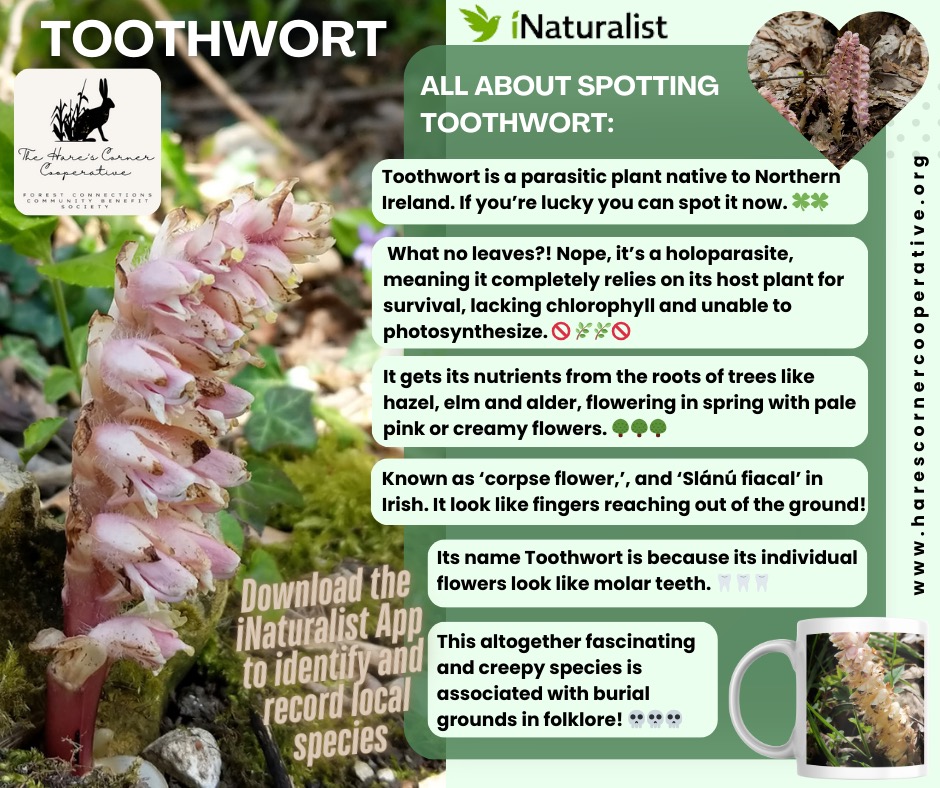
One of the more mysterious and magical plants to appear in early spring is the toothwort. Pale, strange looking, and easy to overlook, this woodland plant doesn’t behave like most others, it has no green leaves, doesn’t photosynthesise, and spends most of its life hidden underground.
Toothwort (Lathraea squamaria) is a native parasitic plant that lives off the roots of trees and shrubs, especially hazel, elm, and alder. Instead of making its own food, it draws nutrients from its host plant using special root like structures. Because of this, it has no need for chlorophyll, which is why it lacks green leaves and instead appears as a cluster of short, pale pink or purplish white flowering spikes.
This unusual plant typically flowers between March and May, emerging briefly above ground to bloom before retreating again. Its flowers grow close to the ground and are tooth shaped, which gives the plant its name. They often appear in small clusters, sometimes in the same spot year after year, especially in ancient or undisturbed woodland.
Toothwort is not common, but it can be found in quiet, shaded woodland areas where its host trees grow. It’s more likely to be spotted by sharp eyed nature lovers who enjoy slowing down and looking closely at the woodland floor during springtime.
Although it may not attract pollinators in the same way as showier plants, toothwort still plays a role in woodland biodiversity. It adds to the rich tapestry of native wildflowers that emerge in spring, and its presence can indicate healthy, established woodland habitat.
Toothwort is a fascinating reminder that not all plants fit our expectations. Some thrive in hidden ways, quietly making their mark on the ecosystems they belong to. If you’re out on a spring walk, take a moment to scan the base of hazel thickets or beside mossy tree roots, you might just spot this pale and curious plant peeking through the leaf litter.
 Hare's Corner Cooperative
Leave a Reply