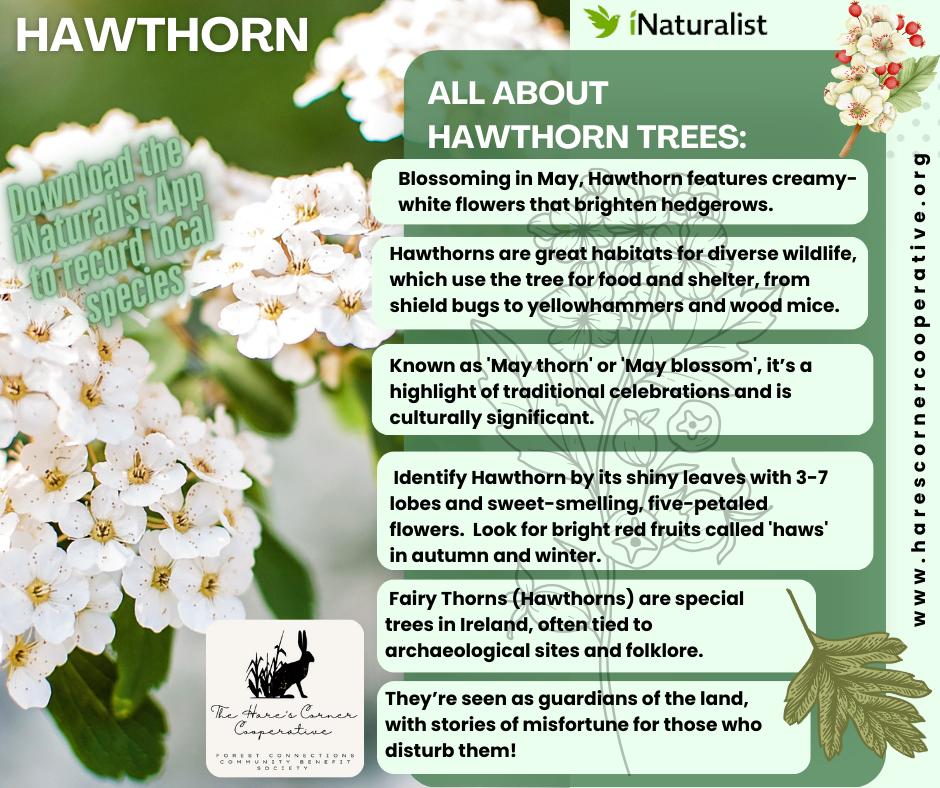
As spring turns to early summer, one of the hedgerow’s most distinctive and beloved sights is the hawthorn tree (Crataegus monogyna) in full bloom. With its creamy white flowers, spiny branches, and rich folklore, hawthorn is a tree deeply woven into both our landscapes and our stories.
Often called the “May tree”, hawthorn blossoms around the month of May, covering hedgerows, woodland edges, and old field boundaries with clusters of tiny five petalled flowers. These sweet scented blossoms are a vital early food source for bees, butterflies, and other pollinators, and their arrival marks an important seasonal turning point in the natural calendar.
Hawthorn is a native species across Ireland and the UK and is well adapted to our climate. Its dense, thorny growth makes it an ideal nesting place for small birds, including robins, wrens, and blackbirds. Later in the year, the tree produces bright red berries called haws, which are a favourite food for birds like thrushes and fieldfares, helping them prepare for migration or survive the colder months.
Hawthorn has a long history in Irish and Celtic folklore, where it is often associated with fairies, boundaries, and protection. It was traditionally considered bad luck to cut down a lone hawthorn, especially if it stood on its own in a field or marked the edge of a site. Some people still leave offerings at hawthorn trees thought to be fairy trees, ties, ribbons, or even coins left respectfully in the branches.
But hawthorn’s value isn’t just mythical, it plays a crucial ecological role too. It supports hundreds of species of insects and provides food and shelter throughout the year. It’s also used in hedgelaying and other traditional land management practices that help maintain healthy, biodiverse habitats.
You can find hawthorn all around the countryside, along trails, in old hedge lines, and scattered through fields. When it blooms, it lights up the land with a soft white glow and a subtle, sweet scent that signals the peak of spring.
Next time you’re out walking and pass a hawthorn in bloom, take a moment to pause. Notice the insects it’s feeding. Look for birds flitting in and out of its branches. Think about all the stories, both old and new, this humble tree holds.
 Hare's Corner Cooperative
Leave a Reply