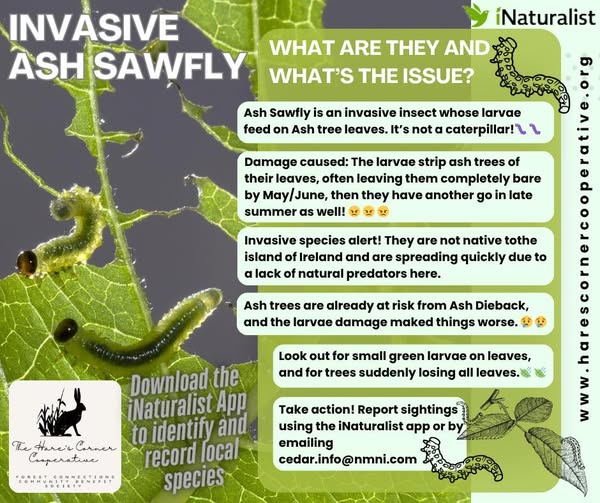
Not every species spotted in the wild is a welcome one. This week, we’re turning our attention to a newcomer that’s causing concern for our native trees, especially ash. Meet the ash sawfly (Tomostethus nigritus), an invasive insect now spreading across parts of Ireland and the UK, including reports from Northern Ireland.
The ash sawfly may be small, but its impact is hard to miss. The larvae, which look a little like tiny green caterpillars, feed in large numbers on the leaves of ash trees, often stripping branches bare in a matter of days. This feeding typically occurs in late spring and early summer, leaving behind ragged, defoliated trees that can look almost scorched. While healthy trees may recover, repeated defoliation weakens them, leaving them vulnerable to disease, drought, and other stressors.
Unlike many of our native leaf eating insects, the ash sawfly doesn’t have many natural predators here to keep its population in check. This allows it to spread quickly and build up in high numbers. The species is believed to be non-native to Ireland, though it has been present in parts of mainland Europe for some time.
One of the biggest concerns is the added pressure this insect places on ash trees, which are already under serious threat from ash dieback disease. Together, disease and insect damage make it even harder for young ash trees to survive and for established trees to remain healthy.
The adult ash sawfly is a small, black, wasp like insect, part of the same order as bees and ants, but it doesn’t sting. It lays its eggs on ash leaves, where the larvae emerge and begin feeding in groups. In the right conditions, the population can explode, leading to widespread damage in just a few weeks.
So what can we do? While there’s currently no simple way to control ash sawfly outbreaks, early identification is important. Keep an eye on ash trees in your area, especially younger trees. If you notice green, curled caterpillar like larvae feeding in groups or sudden leaf loss, take a photo and report the sighting using the iNaturalist app. Recording where outbreaks are happening can help build a clearer picture of the sawfly’s spread, and guide future conservation and response efforts.
As always, our forests and hedgerows are full of stories, some ancient, some still unfolding. The rise of the ash sawfly is a reminder of how delicate the balance is, and how easily it can be disrupted. But by observing, recording, and sharing, we can help protect what’s here and plan for what’s ahead.
 Hare's Corner Cooperative
Leave a Reply